
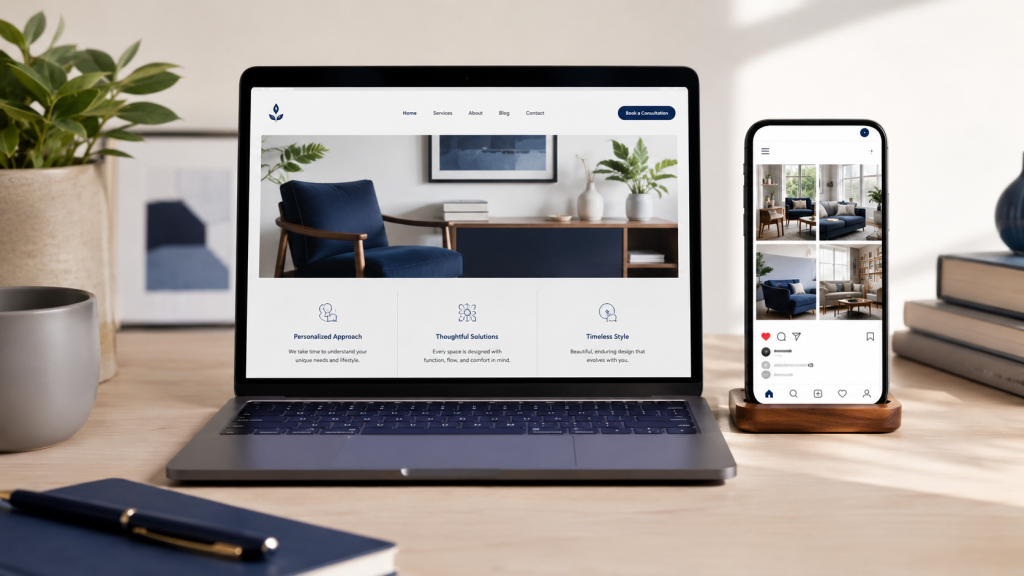
They Solve Different Problems
A website and a social media profile are both online assets, but they are not interchangeable. Social media is often good at visibility and familiarity. A website is stronger at structure, detail, and conversion.
Businesses run into trouble when they expect social media to replace a proper website or expect a website alone to provide constant visibility without any supporting activity.
Why Websites Usually Drive More Direct Sales
A website gives you control. You decide how services are presented, how proof is displayed, how pages are structured, and how visitors move toward a call, form, or booking.
It also supports high-intent traffic better. Someone landing on a service page from search is often already evaluating a decision, not casually browsing a feed.
Where Social Media Helps
Social media helps create repeated exposure. It keeps the brand visible, supports referrals, and lets people see recent activity. For some businesses, especially visual or personality-driven brands, that matters a great deal.
It can also reinforce trust before the sale. Prospects often check social profiles to see if a business seems active, current, and real.
Why the Best Answer Is Usually Both
For many businesses, the strongest setup is website first, social second. The website should handle the serious trust-building and conversion work, while social media keeps the brand familiar and supports discovery.
A weak website plus active social media often creates attention without enough action. A strong website with modest but consistent social support usually performs better.
How to Decide Where to Invest First
If customers search locally for your service and compare providers seriously, the website deserves priority. If customers buy largely on visuals, personality, or ongoing engagement, social media deserves more attention.
The key is to invest according to buyer behavior, not according to whichever channel is currently being hyped.
What Sales Really Respond To
Sales usually respond to trust, clarity, proof, and convenience. A website often handles those more completely than a social feed can.
Social media can bring people into the orbit of the brand, but the website often determines whether that attention becomes a serious lead.
Final Takeaway
The argument should not be website or social media in the abstract. It should be how each one supports the customer journey.
In many cases, the website is what drives the sale, and social media is what helps the brand stay visible long enough to be considered.
Frequently Asked Questions
Can social media replace a website?
For most businesses, no. It can support trust, but it does not provide the same depth or control.
What should be improved first on a limited budget?
Usually the website, especially the pages that shape trust and capture inquiries.
Do I need both?
Often yes, but they do not need equal effort.
A Practical Next Step
A useful way to move forward is to review your current website the way a first-time prospect would. Ask whether the offer is obvious, whether trust is visible, and whether the next step feels easy. That simple exercise often reveals the biggest weaknesses quickly.
When businesses fix the pages that shape first impressions and major decisions, they usually see stronger results without needing to overcomplicate the website. Better structure, clearer proof, and cleaner calls to action go further than many owners expect.
How to Review This on Your Own Site
If you want to apply this topic to your own website, start by looking at the pages that influence first impressions most: the homepage, the main service pages, and the contact path. Read them as if you were a first-time visitor with no prior context. The goal is to identify where the message becomes vague, where trust feels weak, and where the next step feels harder than it should. Most business websites do not fail because of one dramatic mistake. They fail because several small points of friction are allowed to remain in place.
A practical review should include the headline, the opening section, visible proof, mobile usability, page speed, and how easily a visitor can contact the business. If the site forces the user to guess what the company actually does, whether it serves their area, or what happens after they click a button, that uncertainty lowers performance. Strong websites reduce uncertainty quickly.
What Better Results Usually Look Like
Better performance does not always mean a massive redesign. Often it starts with clearer positioning, stronger proof, and better page structure. A revised headline can improve engagement. A more useful service page can improve relevance. A simpler form can increase inquiries. A better placement of reviews can increase trust. These are not glamorous changes, but they are the kind of changes that affect business results directly.
One reason these improvements work is that they align with real buying behavior. Visitors do not arrive hoping to admire your layout. They arrive trying to answer questions quickly: Is this business credible? Do they offer what I need? Can they help someone like me? What should I do next? A good website answers those questions in the right order.
What to Prioritize First
If time or budget is limited, start with the areas closest to revenue. Improve the homepage message, tighten the top service pages, add stronger trust signals, and simplify the primary call to action. Those steps usually create a better return than spending energy on lower-impact cosmetic details. Once that foundation is stronger, you can expand the site with more content, better SEO targeting, and supporting pages that reinforce authority.
The main point is simple: a website becomes more valuable when it is treated like a sales and trust asset instead of a digital placeholder. That perspective changes how businesses invest in content, design, and structure. It also leads to decisions that support growth over time instead of just making the site look temporarily updated.